C++ Example - Finding the Roots of a Quadratic Equation
Quadratic equationax2+bx+c = 0(where a≠0), a is the coefficient of the quadratic term, bx is called the linear term, b is the coefficient of the linear term; c is called the constant term.
The value of x is:
Discriminant of the roots
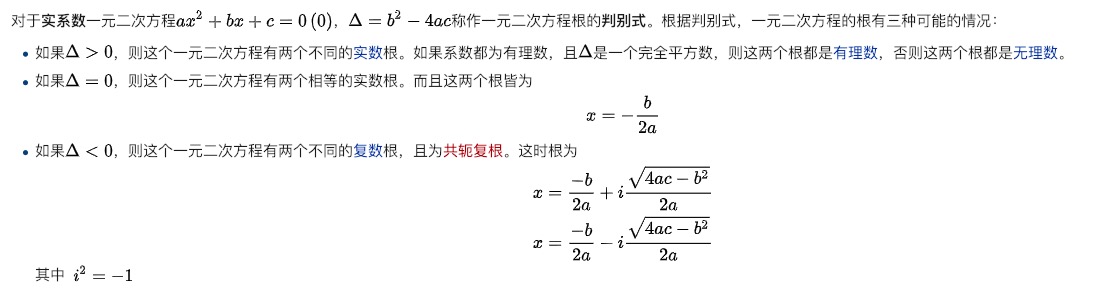

Example
#include <iostream>
#include <cmath>
using namespace std;
int main() {
float a, b, c, x1, x2, discriminant, realPart, imaginaryPart;
cout << "Enter a, b, and c:";
cin >> a >> b >> c;
discriminant = b*b - 4*a*c;
if (discriminant > 0) {
x1 = (-b + sqrt(discriminant)) / (2*a);
x2 = (-b - sqrt(discriminant)) / (2*a);
cout << "Roots are real and different." << endl;
cout << "x1 = " << x1 << endl;
cout << "x2 = " << x2 << endl;
}
else if (discriminant == 0) {
cout << "Same real roots:" << endl;
x1 = (-b + sqrt(discriminant)) / (2*a);
cout << "x1 = x2 =" << x1 << endl;
}
else {
realPart = -b/(2*a);
imaginaryPart =sqrt(-discriminant)/(2*a);
cout << "Different real roots:" << endl;
cout << "x1 = " << realPart << "+" << imaginaryPart << "i" << endl;
cout << "x2 = " << realPart << "-" << imaginaryPart << "i" << endl;
}
return 0;
}
The output of the above program execution is:
输入 a, b 和 c: 4 5 1 实根不同: x1 = -0.25 x2 = -1other extensions